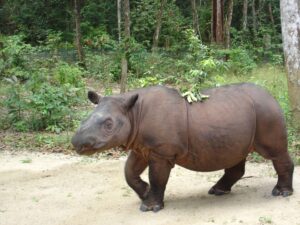
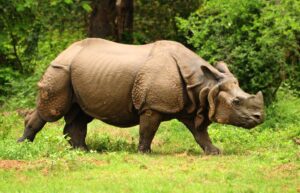
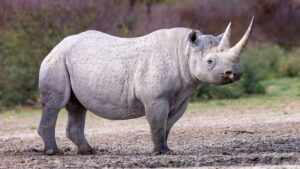
The Javan rhinoceros is one of the rarest large mammals on Earth. Once widespread across Southeast Asia, it now survives only in Ujung Kulon National Park, where rangers and camera traps watch over it.
Interesting facts
- Fewer than 80 remain, and the true number may be lower.
- A poaching gang killed at least 26 Javan rhinos between 2019 and 2023.
- Males have a single horn, usually less than 25 cm long; many females have no horn.
- Its skin has folds that look like plates of armour.
- Javan rhinos once ranged from northeast India to Indonesia.
- Almost all knowledge of the living population comes from camera traps.
Behaviour
Javan rhinos are solitary except for mothers and calves. They wallow in mud and are rarely seen, even by the rangers who protect them.
Breeding and young
After a gestation of about 16 months, a single calf is born. Females breed every few years, so population growth is very slow.
Threats and conservation
Poaching for horn, inbreeding in a tiny population, disease, natural disasters such as tsunamis from nearby volcanoes, and invasive palm plants that crowd out food plants.
Where to see it
- Not possible to see as a tourist
- Ujung Kulon National Park protects the entire population
- Camera-trap footage is shared by conservation organisations
- Support anti-poaching and habitat work
Status source: IUCN Red List. Profile last reviewed September 2026.