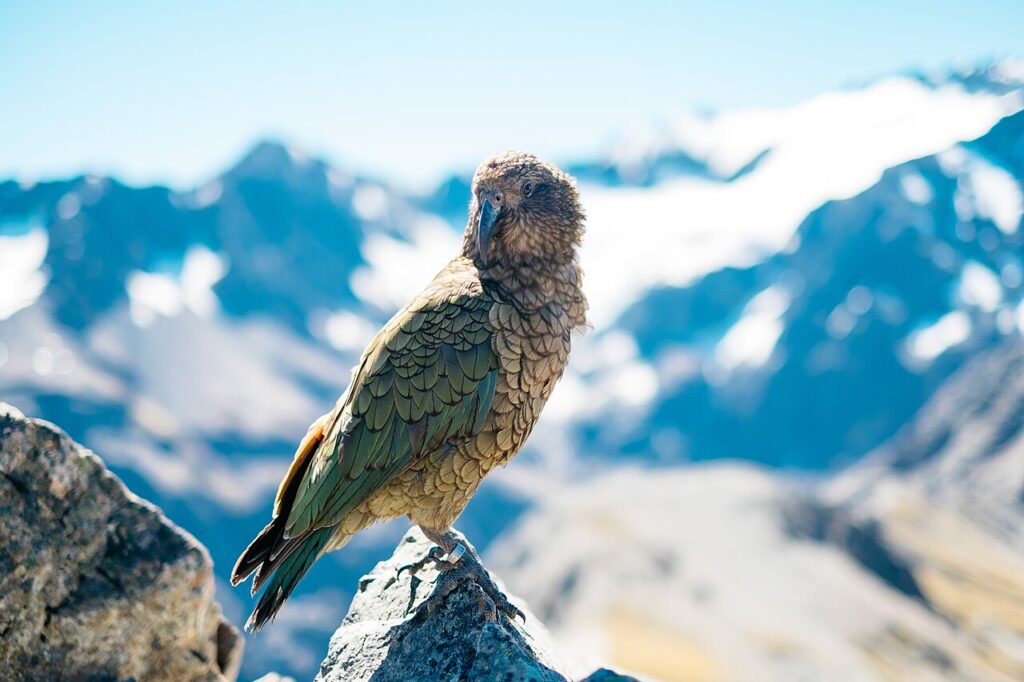
New Zealand split from other landmasses about 80 million years ago, and its wildlife evolved without land mammals except bats. Birds filled the niches that mammals occupy elsewhere, giving rise to flightless kiwi, the parrot-like kea and the kākāpō. Many species declined after people introduced rats, stoats and possums, but a remarkable network of predator-free islands and fenced sanctuaries is bringing them back.
At a glance
| Best time | October to April (spring and summer) |
| Getting there | Fly to Auckland or Christchurch |
| Time needed | 2 to 3 weeks |
| Big draws | Kiwi, kea, penguins, albatrosses, whales, dolphins |
| Good for | Road trips, hikers, families |
Birds
- Kiwi: nocturnal, flightless and hard to see in the wild. The best chances are on Stewart Island and in sanctuaries such as Zealandia (Wellington) and Tiritiri Matangi. See our kiwi profile and Stewart Island guide.
- Kea: the world’s only alpine parrot, intelligent and curious, found in the Southern Alps around Arthur’s Pass and Milford Road. See our kea profile.
- Kākāpō: a critically endangered flightless parrot living on predator-free islands; visitors cannot usually see them, but conservation progress has been remarkable. See our kākāpō profile.
- Takahē, saddlebacks, stitchbirds and kōkako on predator-free islands.
- Royal albatrosses: the only mainland albatross colony in the world, at Taiaroa Head on the Otago Peninsula. See our wandering albatross profile for a relative.
Penguins
- Yellow-eyed penguins (hoiho): one of the world’s rarest penguins, seen from hides on the Otago Peninsula and the Catlins.
- Little penguins (kororā): the world’s smallest penguin, at colonies such as Oamaru.
- Fiordland crested penguins (tawaki): in Fiordland and on the West Coast in winter and spring.
Marine mammals
- Sperm whales year-round at Kaikōura. See our Kaikōura guide.
- Hector’s dolphins, among the world’s smallest and rarest dolphins, at Akaroa and the Catlins.
- New Zealand sea lions on the Otago Peninsula and in the Catlins; fur seals along much of the coast.
- Orcas, dusky dolphins and humpback whales seasonally.
Predator-free sanctuaries
- Zealandia (Wellington): a fenced urban sanctuary with kākā, takahē and night tours for kiwi.
- Tiritiri Matangi (near Auckland): an island restored by volunteers, with many rare birds.
- Ulva Island (Stewart Island): pristine forest with abundant birds.
- Orokonui Ecosanctuary (Dunedin).
Predator Free 2050
New Zealand has set a goal to eradicate rats, stoats and possums from the whole country by 2050, an ambitious effort supported by communities across the nation.
When to go
- October to April: spring and summer; breeding birds, penguins and albatrosses at colonies.
- May to September: winter; fewer visitors; good for some whales and seals.
Frequently asked questions
Where can I see kiwi in the wild? Stewart Island is the best place, followed by night tours at sanctuaries such as Zealandia.
Where can I see kea? In the Southern Alps, especially at Arthur’s Pass and along the road to Milford Sound. Do not feed them.
Can I see penguins in New Zealand? Yes: yellow-eyed penguins on the Otago Peninsula, little penguins at Oamaru, and Fiordland crested penguins on the West Coast.
Are there dangerous animals in New Zealand? No dangerous land animals, though care is needed with sea lions and at sea.
Related guides
- Seeing wild kiwi on Stewart Island
- Kaikōura whale watching
- Tasmania wildlife guide
- Animal profiles: Kiwi, Kea, Kākāpō
Cover photo: Pablo Heimplatz pabloheimplatz, CC0, via Wikimedia Commons