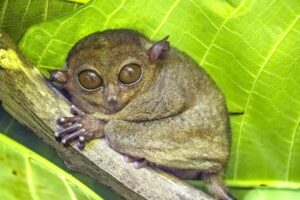
Slow lorises are small, nocturnal primates with large, round eyes and a slow, deliberate way of moving. Their appealing looks have made them victims of the illegal pet trade.
Interesting facts
- When a loris raises its arms above its head, it is not asking to be tickled; it is getting ready to use its venom.
- Viral videos of ‘tickled’ lorises have fuelled the illegal pet trade.
- Special blood vessels in their limbs let them grip branches for hours without tiring.
- They move slowly and silently to avoid being noticed.
- Their large eyes reflect light brightly at night.
- Traders often cut or pull out lorises’ teeth, causing pain and infection.
Behaviour
Slow lorises are solitary and nocturnal, moving carefully through the branches in search of gum, nectar and insects. They freeze when threatened.
Breeding and young
After about six months, a single infant or twins are born. Mothers sometimes ‘park’ infants on branches while they feed.
Threats and conservation
The illegal pet trade, trade for traditional medicine, habitat loss and electrocution on power lines.
Where to see it
- Danum Valley and Kinabatangan River, Sabah, on night walks
- West Java, with the Little Fireface Project
- Kaeng Krachan National Park, Thailand
- Never pay for photos with lorises or buy them as pets
Status source: IUCN Red List. Profile last reviewed September 2026.
Where to see the slow loris
 Danum Valley Rainforest GuideDanum Valley protects some of the tallest and oldest lowland rainforest on Earth. What to see, how to…
 Khao Yai and Kaeng Krachan: Thailand’s Wildlife ParksJust a few hours from Bangkok, Khao Yai and Kaeng Krachan offer wild elephants, gibbons and hornbills in…
 Cat Tien and Cuc Phuong: Primates of VietnamVietnam's forests are home to some of the world's rarest primates. How to see gibbons, langurs and the…