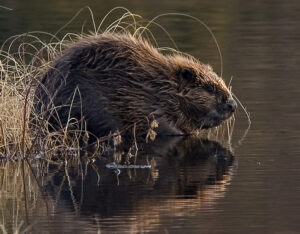
The North American beaver is a large, semi-aquatic rodent and one of nature’s greatest engineers. By building dams and lodges, it transforms streams into ponds and wetlands, creating habitat for many other species.
Interesting facts
- It is the largest rodent in North America and the second-largest in the world, after the capybara.
- Beavers’ front teeth are orange because they contain iron, which makes them stronger.
- Beavers can stay underwater for up to about 15 minutes.
- Beaver ponds create wetlands that support fish, birds, amphibians and insects.
- Demand for beaver fur drove much of the European exploration of North America.
- Beavers introduced to Tierra del Fuego in 1946 now number tens of thousands and damage native forests.
Behaviour
Beavers live in family groups called colonies. They build dams of sticks, mud and stones to raise water levels, and lodges with underwater entrances for safety. In autumn, they store branches underwater near the lodge to eat through the winter.
Breeding and young
Beavers usually pair for life. After about 105 days, females give birth to two to four kits in the lodge in spring. Young beavers stay with their parents for about two years before leaving to start their own colonies.
Threats and conservation
Beavers were trapped almost to extinction by about 1900 but recovered with protection and reintroductions. Today they are sometimes removed because of flooding and tree damage.
Where to see it
- Algonquin Provincial Park, Ontario, Canada
- Rocky Mountain National Park, Colorado
- Grand Teton and Yellowstone national parks, USA
- Look for them at dusk near dams and lodges
Status source: IUCN Red List. Profile last reviewed September 2026.