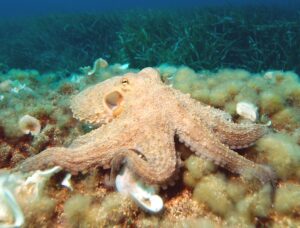
The giant Pacific octopus is the largest and longest-lived octopus. It is highly intelligent, capable of solving puzzles and opening jars, and lives in the cold, rich waters of the North Pacific.
Interesting facts
- It is the largest octopus species in the world.
- It has three hearts and blue blood.
- Each of its eight arms has hundreds of suckers that can taste as well as grip.
- It can squeeze through any gap larger than its hard beak.
- It changes colour and skin texture in a fraction of a second for camouflage and signalling.
- A mother guards her eggs for about six months without eating, and dies soon after they hatch.
Behaviour
Giant Pacific octopuses are solitary and mostly nocturnal. They hide in dens among rocks, leaving piles of crab shells outside. They hunt by feeling in crevices with their arms and use a toxic saliva and a sharp beak to eat prey.
Breeding and young
After mating, the female lays tens of thousands of eggs in strings attached to the roof of her den. She cleans and aerates them constantly until they hatch into tiny, drifting larvae.
Threats and conservation
The species is not considered threatened, but it is caught in some fisheries and may be affected by ocean warming.
Where to see it
- Puget Sound, Washington, on dives from Seacrest Park
- Vancouver Island, British Columbia
- Seattle Aquarium and Monterey Bay Aquarium
- Tide pools of Alaska and British Columbia (small individuals)
Status source: IUCN Red List. Profile last reviewed September 2026.