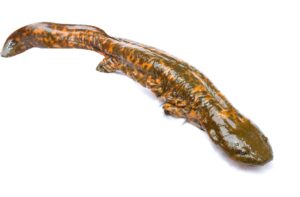
The Chinese giant salamander is a living fossil and the largest amphibian alive. Wild populations have declined catastrophically, mainly because of overharvesting for luxury food, and surveys in the 2010s found very few animals in the wild.
Interesting facts
- It breathes largely through its wrinkled skin.
- It has very poor eyesight and hunts by sensing vibrations.
- It can make sounds said to resemble a crying baby.
- Its lineage dates back to the time of the dinosaurs.
- Millions are farmed for food, but wild populations have collapsed.
- Releases of farmed animals of mixed origin may harm wild genetic diversity.
Behaviour
It hides under rocks by day and ambushes prey at night with a rapid suction bite.
Breeding and young
Females lay strings of eggs in underwater burrows, which males guard until they hatch.
Threats and conservation
Overharvesting for food, habitat loss, dams, pollution and disease.
Where to see it
- Extremely rare in the wild; some Chinese reserves and zoo conservation programmes
Status source: IUCN Red List. Profile last reviewed September 2026.