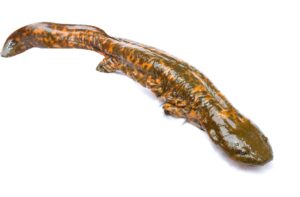
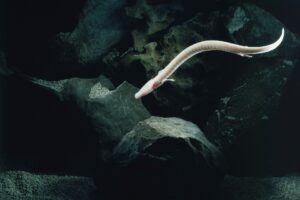
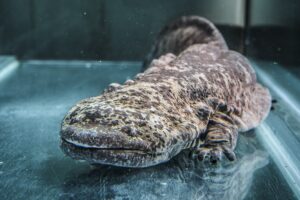
The axolotl is a salamander that never undergoes full metamorphosis, remaining aquatic all its life. It is common in aquariums and laboratories worldwide but Critically Endangered in the wild, where it survives only in the remnants of Mexico City’s ancient lake system.
Interesting facts
- Axolotls keep their larval features, including feathery external gills, throughout life, a trait called neoteny.
- They breathe through gills, skin and simple lungs.
- Wild axolotls are usually dark brown or grey; pink ones are mainly bred in captivity.
- The name comes from Nahuatl and is often linked to Xolotl, an Aztec god.
- Axolotls are widely studied in regeneration research.
- Surveys suggest wild numbers have fallen dramatically since the 1990s.
Behaviour
Axolotls live on the bottom of canals and lakes and are mostly active at night. They suck in prey with a sudden gulp.
Breeding and young
Females lay hundreds of eggs, attaching them to plants and rocks. Young hatch after about two weeks.
Threats and conservation
Urban expansion, water pollution, introduced fish such as carp and tilapia that eat eggs and young, and drainage of wetlands.
Where to see it
- Xochimilco, Mexico City (chinampa conservation projects)
- Museo del Axolote (Anfibium), Mexico City
Status source: IUCN Red List. Profile last reviewed September 2026.