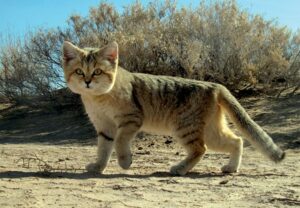
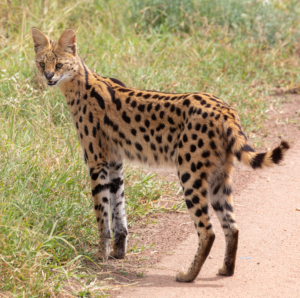
The caracal is a sleek, reddish-brown cat with striking black ear tufts. It is found across Africa and western and southern Asia and is highly adaptable, living in habitats from semi-desert to mountain forest. Its extraordinary jumping ability makes it a formidable hunter of birds.
Interesting facts
- Its name comes from the Turkish ‘karakulak’, meaning ‘black ear’.
- Long black ear tufts may help communication between caracals.
- It was once trained to hunt birds for royalty in Persia and India.
- Caracals live on the edge of Cape Town, where scientists study how they cope with city life.
- In India, caracals have become extremely rare.
- It is sometimes called the ‘desert lynx’, but it is not a true lynx.
Behaviour
Caracals are solitary and mostly nocturnal, although they are active by day in cooler seasons and quieter areas. They stalk prey closely before a quick rush or leap. They are strong climbers and sometimes cache kills in trees.
Breeding and young
After about 70–80 days, females give birth to one to four kittens in a burrow, rock crevice or thick vegetation. Kittens become independent at around 9–10 months.
Threats and conservation
Caracals are widespread in Africa, but they are killed by farmers as livestock predators, especially in southern Africa. In Asia, habitat loss and persecution have caused declines, and they are rare in India and Central Asia.
Where to see it
- Kgalagadi Transfrontier Park, South Africa and Botswana
- Etosha National Park, Namibia
- Ngorongoro Crater and the Serengeti, Tanzania (occasional)
- Cape Peninsula, South Africa (rarely seen)
Status source: IUCN Red List. Profile last reviewed September 2026.