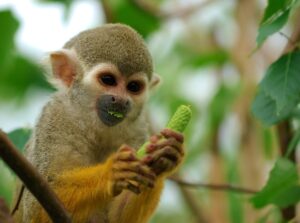
Capuchins are clever, adaptable monkeys of Central and South America, known for tool use and complex social lives. They live in many habitats and eat a wide range of foods.
Interesting facts
- Capuchins are named after Capuchin friars, whose hooded robes resemble their colouring.
- They rub millipedes and plants on their fur, possibly to repel insects.
- Capuchins are among the most intelligent monkeys, with large brains for their size.
- White-faced capuchins in Costa Rica have social traditions that vary between groups.
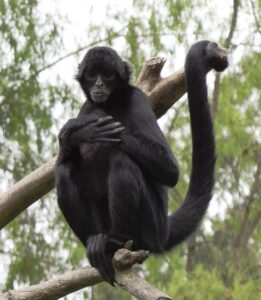
- Their tails are prehensile, although not as strongly as spider monkeys’.
- They often forage noisily, breaking branches and turning over bark.
Behaviour
Capuchins live in groups of about 10 to 40. They forage actively through the forest, investigating bark, leaves and holes for food, and some populations regularly use tools.
Breeding and young
After about five and a half months, a single infant is born. Other group members help care for it.
Threats and conservation
Deforestation, hunting and the pet trade.
Where to see it
- Manuel Antonio and Corcovado national parks, Costa Rica
- Serra da Capivara National Park and Fazenda Boa Vista, Brazil (tool-using capuchins)
- Iguaçu National Park, Brazil and Argentina
- Amazon lodges in Peru and Ecuador
Status source: IUCN Red List. Profile last reviewed September 2026.