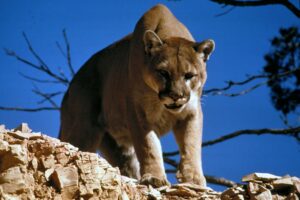
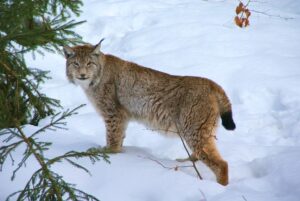
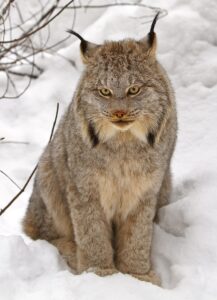
The bobcat is a medium-sized, adaptable wild cat found across most of North America. It shares the lynx genus with the Canada lynx and Eurasian lynx but lives further south and in a much wider range of habitats, from swamps to deserts.
Interesting facts
- Its name comes from its short, ‘bobbed’ tail.
- Bobcats are about twice the size of a domestic cat.
- They are highly adaptable and increasingly live on the edges of towns and cities.
- Bobcats can take prey as large as deer, usually by ambushing them while they rest.
- They are mostly active at dawn and dusk.
- Their spotted coat varies from grey to reddish-brown.
Behaviour
Bobcats are solitary and territorial. They hunt by stealth, using cover to creep close before pouncing. Territories are marked with scent, scratches and faeces. Bobcats are good climbers and swimmers, but spend most of their time on the ground.
Breeding and young
Bobcats usually mate in late winter. After about two months, one to six kittens are born in a den in a rock crevice, hollow log or thicket. Kittens start hunting with their mother at about five months and disperse in their first year.
Threats and conservation
Bobcats are widespread and secure overall. Local threats include habitat loss, road deaths, rodenticide poisoning and regulated trapping for fur.
Where to see it
- Point Reyes National Seashore, California
- Everglades and Big Cypress, Florida
- Sonoran Desert, Arizona
- Yellowstone and other western parks (rare sightings)
Status source: IUCN Red List. Profile last reviewed September 2026.