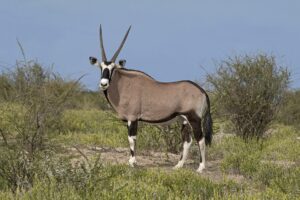
The Arabian oryx is a small, white oryx of the Arabian deserts. After being hunted to extinction in the wild, it has returned thanks to one of the world’s most famous conservation success stories.
Interesting facts
- The last wild Arabian oryx were shot in Oman in 1972.
- A captive ‘world herd’ started in the 1960s saved the species.
- Reintroductions began in Oman in 1982.
- Its white coat reflects sunlight, and its broad hooves help it walk on sand.
- Arabian oryx seem able to detect rain from far away and travel towards it.
- Seen from the side, its two horns can look like one, which may have inspired unicorn legends.
Behaviour
Arabian oryx live in herds of mixed sexes and ages. They rest in the shade during the heat of the day, sometimes digging shallow hollows, and feed at dawn, dusk and night.
Breeding and young
After a gestation of about eight months, a single calf is born. Calves can follow the herd within hours.
Threats and conservation
Poaching (including capture for private collections), drought, overgrazing by livestock and habitat loss.
Where to see it
- Mahazat as-Sayd Protected Area, Saudi Arabia
- Shaumari Wildlife Reserve and Wadi Rum, Jordan
- Al Marmoom Desert Conservation Reserve, Dubai
- Sir Bani Yas Island, Abu Dhabi
Status source: IUCN Red List. Profile last reviewed September 2026.
 Oman Wildlife: Turtle Nesting at Ras al Jinz