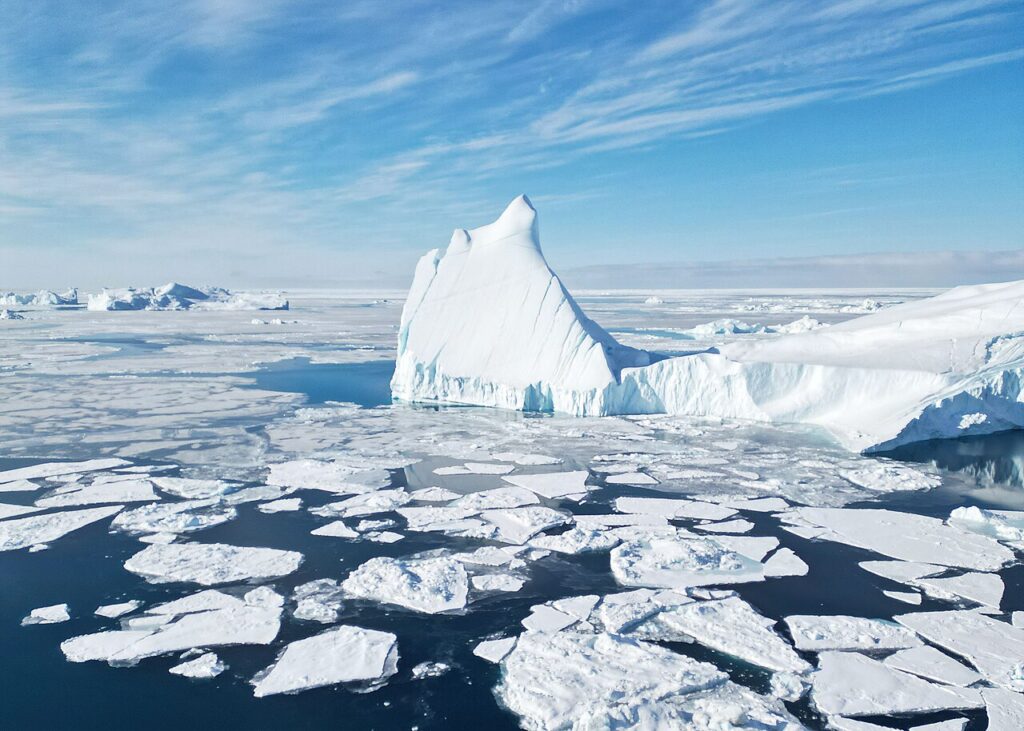
Greenland, the world’s largest island, is mostly covered by an ice sheet up to about 3 km thick. Its ice-free coasts hold musk oxen, Arctic foxes and reindeer, and its waters are rich in whales, seals and seabirds. With about 56,000 people, mostly Inuit, living in small coastal towns, it is one of the most sparsely populated places on Earth.
At a glance
| Best time | June to September (summer); also winter for dog sledding and northern lights |
| Getting there | Flights from Copenhagen or Reykjavík (Nuuk’s new international airport opened in 2024) |
| Time needed | 7 to 14 days |
| Big draws | Icebergs, humpback whales, musk oxen, Inuit culture |
| Good for | Adventurous travellers, photographers |
Wildlife
- Musk oxen: shaggy, prehistoric-looking herbivores, easily seen on tundra around Kangerlussuaq in West Greenland, where they were introduced in the 1960s, and in the vast Northeast Greenland National Park. See our musk ox profile.
- Whales: humpback, fin and minke whales feed in Disko Bay and around Nuuk in summer; bowhead whales in Disko Bay in spring; narwhals in the far north. See our humpback whale profile.
- Arctic foxes, Arctic hares and reindeer. See our Arctic fox profile.
- Polar bears: mainly in the north and east; rarely seen by visitors.
- Seabirds: little auks, Brünnich’s guillemots, eiders and white-tailed eagles in the south-west.
Where to go
- Ilulissat and Disko Bay: the Ilulissat Icefjord (a UNESCO site) produces huge icebergs from one of the world’s fastest-moving glaciers. Boat trips cruise among icebergs with humpback whales.
- Kangerlussuaq: the main airport hub, with musk oxen on the tundra and a road to the edge of the ice sheet.
- Nuuk: the capital, with fjord trips for whales.
- East Greenland: Scoresby Sund and Tasiilaq, reached mainly by expedition cruises or small flights; remote and spectacular.
Culture
Inuit culture shapes life in Greenland: kayaks (qajaq) were invented here, dog sledding remains important in the north, and hunting is still part of life. Visit local museums and buy crafts from local artists.
When to go
- June to August: midnight sun, whales, boat trips, hiking.
- September: autumn colours, the northern lights and fewer visitors.
- February to April: dog sledding, snowmobiling and northern lights.
Climate change
Greenland’s ice sheet is melting at an accelerating rate, contributing to sea-level rise. Glaciers such as Jakobshavn (Sermeq Kujalleq) near Ilulissat are studied closely by scientists.
Frequently asked questions
Where can I see musk oxen in Greenland? Around Kangerlussuaq in West Greenland, on guided tundra safaris.
When is the best time to see whales in Greenland? June to September, especially in Disko Bay and around Nuuk.
Can I see polar bears in Greenland? Rarely. They live mainly in remote northern and eastern areas.
How do I get around Greenland? There are almost no roads between towns; travel is by plane, boat or expedition cruise.
Related guides
- Arctic wildlife cruises
- Narwhal and polar bear expeditions in Arctic Canada
- Where to see puffins in Iceland
- Animal profiles: Musk ox, Arctic fox, Humpback whale
Cover photo: Quintin Soloviev, CC BY 4.0, via Wikimedia Commons