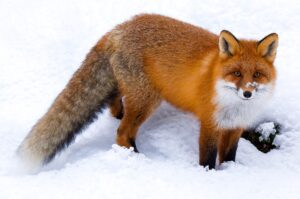
The Arctic fox is a small, hardy fox that lives in some of the coldest places on Earth. Its thick coat, compact body and ability to travel great distances let it survive long Arctic winters, feeding on lemmings, birds and scraps from polar bear kills.
Interesting facts
- Its coat changes from brown or grey in summer to white in winter; a ‘blue’ form stays dark grey all year.
- Its dense winter fur is among the warmest of any mammal.
- Short ears, a short muzzle and furry foot pads reduce heat loss.
- In lemming boom years, Arctic foxes can have very large litters, sometimes more than 15 pups.
- It is Iceland’s only native land mammal.
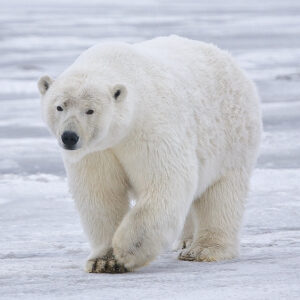
- Arctic foxes often follow polar bears to scavenge their kills.
Behaviour
Arctic foxes live in family groups during the breeding season in complex dens that may be used for generations. In winter, many travel widely over the tundra and sea ice. They can hear lemmings under the snow and pounce to break through.
Breeding and young
Pairs usually mate for life. After about 52 days, the female gives birth to a litter whose size depends on food supply. Both parents, and sometimes older offspring, help raise the pups.
Threats and conservation
Climate change is allowing the larger red fox to spread north and compete with Arctic foxes, while changing lemming cycles reduce food. The Scandinavian population was nearly wiped out by fur hunting and remains small, despite conservation work.
Where to see it
- Hornstrandir Nature Reserve, Iceland
- Svalbard, Norway
- Churchill, Manitoba, Canada
- Dovrefjell National Park, Norway (reintroduced population)
Status source: IUCN Red List. Profile last reviewed September 2026.
 Svalbard Polar Bear Expeditions
 Greenland Wildlife: Musk Oxen, Whales and Icebergs