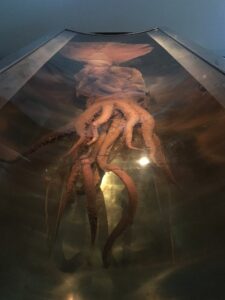
The giant squid is one of the largest invertebrates on Earth and a creature of legend. It lives in the deep ocean and was known mostly from carcasses until the 21st century, when scientists finally photographed and filmed it alive.
Interesting facts
- The first photographs of a live giant squid in the deep sea were taken in 2004 near Japan.
- It was first filmed in its natural habitat in 2012.
- Sperm whales hunt giant squid, and some whales carry scars from their suckers.
- Its suckers are lined with sharp, toothed rings.
- Legends of the kraken may have been inspired by giant squid.
- A giant squid called Archie, over 8 m long, is displayed at the Natural History Museum in London.
Behaviour
Very little is known about its behaviour. It probably hunts by waiting in the dark and seizing prey with its two long tentacles, pulling it towards its beak.
Breeding and young
Little is known. Females are thought to release large masses of tiny eggs.
Threats and conservation
No major threats are known, although deep-sea fishing and ocean noise may affect it.
Where to see it
- Natural History Museum, London
- Smithsonian National Museum of Natural History, Washington, D.C.
- Melbourne Museum, Australia
- Te Papa, Wellington, New Zealand, which displays the related colossal squid
Status source: IUCN Red List. Profile last reviewed September 2026.