The Portuguese man o’ war is a striking, blue-purple floating colony found in warm oceans. Its long tentacles deliver powerful stings, and strong onshore winds can wash thousands onto beaches.
Interesting facts
- It is not a true jellyfish but a siphonophore.
- Its gas-filled float acts as a sail, and the colony drifts wherever wind and currents take it.
- Its stinging tentacles are very painful, even on animals washed up on the beach.
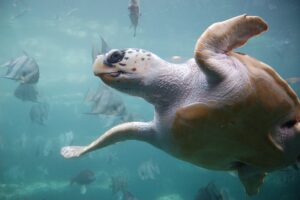
- Loggerhead turtles and a sea slug called the blue dragon eat man o’ wars.
- The blue dragon sea slug stores the man o’ war’s stinging cells and uses them for its own defence.
- It is named after an 18th-century Portuguese warship under full sail.
Behaviour
The float is shaped so that the colony sails at an angle to the wind. Some colonies sail to the left and some to the right, which may help spread populations. Tentacles trail below to catch prey.
Breeding and young
Colonies grow by budding new members. Reproductive members release eggs and sperm into the water, producing new colonies.
Threats and conservation
Not considered threatened.
Where to see it
- Atlantic beaches of Florida and the Caribbean after onshore winds
- The Canary Islands and the Azores
- Australian beaches in summer (the related bluebottle)
- Never touch one, even if it is washed up and looks dead
Status source: IUCN Red List. Profile last reviewed September 2026.