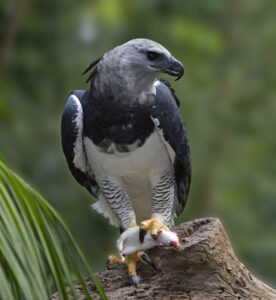
The Philippine eagle is a huge, crested forest eagle found only in the Philippines. It is a top predator of the rainforest and a national symbol, but deforestation has made it one of the rarest birds of prey in the world.
Interesting facts
- It was once called the monkey-eating eagle.
- It became the national bird of the Philippines in 1995.
- About 400 breeding pairs are thought to remain.
- Pairs raise a single chick only once every two years.
- Its shaggy crest makes it look like a lion’s mane.
- Each pair needs a large area of forest, often more than 60 km².
Behaviour
Philippine eagles hunt in the forest canopy, often in pairs, with one bird distracting prey while the other attacks. They perch quietly and scan for movement, then fly between trees with great agility despite their size.
Breeding and young
Pairs mate for life and build large stick nests high in tall trees. The female lays one egg, which both parents incubate for about 60 days. The chick depends on its parents for well over a year.
Threats and conservation
Deforestation from logging, farming and mining; shooting and trapping; and the very slow breeding rate, which makes every loss significant.
Where to see it
- Philippine Eagle Center, Davao City, Mindanao
- Mount Apo Natural Park, Mindanao, with licensed guides
- Mount Kitanglad Range Natural Park, Mindanao
- Community-based eagle nest tours organised with the Philippine Eagle Foundation
Status source: IUCN Red List. Profile last reviewed September 2026.