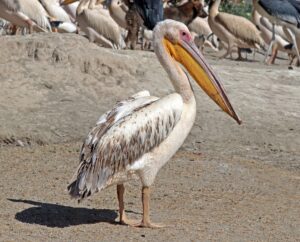
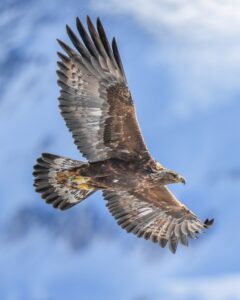
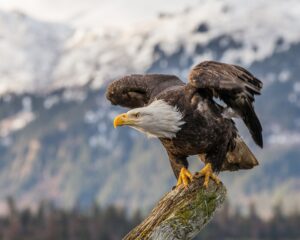
The osprey, or fish hawk, is a large, brown-and-white bird of prey found on every continent except Antarctica. It is a specialist fish hunter and one of the most widely distributed birds in the world.
Interesting facts
- Its outer toe can swing backwards, so it can grip a fish with two toes in front and two behind.
- Spiny pads on the soles of its feet help it hold slippery fish.
- Ospreys carry fish head-first to reduce air resistance.
- They can close their nostrils when diving.
- Osprey numbers crashed because of DDT pesticides in the mid-1900s and recovered after DDT was banned.
- Some ospreys fly over 4,000 km between Europe and West Africa each year.
Behaviour
Ospreys hover or circle over water, then dive feet-first to seize fish near the surface. They build large stick nests on dead trees, cliffs, poles and specially built platforms, often returning to the same nest year after year.
Breeding and young
Pairs usually mate for life. The female lays two to four eggs, incubated for about five weeks. Chicks fledge after about 7–8 weeks.
Threats and conservation
Ospreys have recovered in many areas. Threats include illegal shooting on migration, electrocution on power lines, entanglement in fishing line and pollution.
Where to see it
- Rutland Water and Loch of the Lowes, UK
- Chesapeake Bay, USA
- Florida’s coasts and lakes
- Lakes and coasts almost anywhere in the world
Status source: IUCN Red List. Profile last reviewed September 2026.
Where to see the osprey
 Raptor Migration at the Strait of GibraltarEvery autumn and spring, hundreds of thousands of birds of prey and storks cross the narrow Strait of…
 Rottnest Island Quokkas: Visiting ResponsiblyThe quokka's famous "smile" has made Rottnest Island a global favourite. How to visit without harming these small…