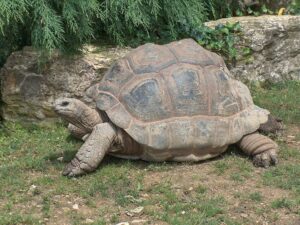
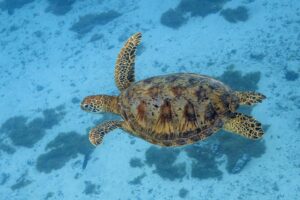
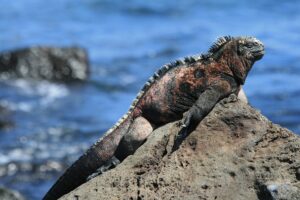
The Galápagos giant tortoises are a group of closely related species, each native to a particular island or volcano. Whalers and settlers killed an estimated 100,000 to 200,000 tortoises, and introduced goats, rats and pigs destroyed habitat and eggs. Intensive conservation has brought several species back from the brink.
Interesting facts
- Galápagos giant tortoises are the largest living tortoises.
- The islands were named after them; ‘galápago’ is an old Spanish word for tortoise.
- Tortoises from different islands have different shell shapes, from domed to saddle-backed.
- Saddle-backed shells let tortoises stretch their necks up to reach tall cacti.
- Lonesome George, the last Pinta Island tortoise, died in 2012.
- In 2019, a Fernandina giant tortoise, thought extinct for over a century, was found alive.
Behaviour
Tortoises spend much of the day grazing and resting, wallowing in mud pools to keep cool and avoid parasites. Some migrate seasonally between the lowlands and the highlands.
Breeding and young
Females dig nests in dry, sunny soil and lay 2 to 16 eggs. Incubation takes about four to eight months, and temperature determines sex.
Threats and conservation
Invasive species, habitat change and, historically, hunting. Captive breeding and eradication of goats and rats on several islands have been very successful.
Where to see it
- El Chato and Rancho Primicias reserves, Santa Cruz Island
- Charles Darwin Research Station breeding centre
- Isabela Island highlands
Status source: IUCN Red List. Profile last reviewed September 2026.
Where to see the galápagos giant tortoise
 Galápagos Islands Wildlife GuideWhere to see giant tortoises, marine iguanas, blue-footed boobies, penguins and sea lions in the Galápagos, the best…
 Galápagos Cruise vs Land-Based Trip: Which Is Right for You?Cruise or island-hop? The choice decides which islands and species you can see. An honest comparison of costs,…