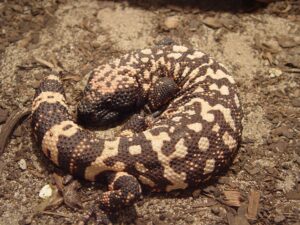
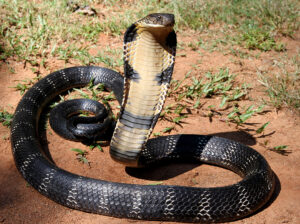
The western diamondback rattlesnake is a large, venomous pit viper of the American Southwest, named for the diamond pattern on its back. It warns intruders with its famous rattle.
Interesting facts
- Its rattle is made of loose segments of keratin, and a new segment is added each time it sheds.
- The number of rattle segments does not show its age, because segments break off.
- Heat-sensing pits between its eyes and nostrils let it ‘see’ warm-blooded prey in the dark.
- It gives birth to live young.
- Most bites happen when people try to handle or kill the snake.
- Rattlesnakes help control rodent populations.
Behaviour
Western diamondbacks are mostly nocturnal in hot weather and active by day in cooler seasons. They ambush prey and often gather in dens to hibernate in winter.
Breeding and young
After mating, females give birth to about 10–20 live young in late summer or early autumn.
Threats and conservation
The species is common, but it is killed on roads, persecuted and collected for ‘rattlesnake roundups’.
Where to see it
- Big Bend National Park, Texas
- Organ Pipe Cactus National Monument, Arizona
- Sonoran Desert, Arizona
- Watch where you step and never try to handle one
Status source: IUCN Red List. Profile last reviewed September 2026.