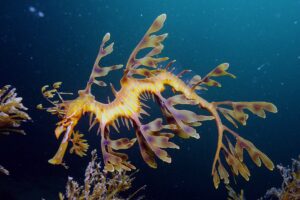
Seahorses are small fish with a horse-like head, a curled tail and bony armour. They are poor swimmers that rely on camouflage, and they are famous for male pregnancy.
Interesting facts
- A male seahorse can give birth to hundreds or even more than a thousand babies at a time.
- Many species form pairs that greet each other every morning with a dance.
- Seahorses have no stomach, so food passes through quickly and they must eat almost constantly.
- Their eyes can move independently, looking in two directions at once.
- They anchor themselves to seagrass and coral with their curling tails.
- Millions of dried seahorses are traded each year for traditional medicine and souvenirs.
Behaviour
Seahorses spend most of their time holding on to plants or coral with their tails. They ambush tiny prey, sucking it in through their snout at high speed. Many can change colour to match their surroundings.
Breeding and young
After courtship, the female transfers her eggs into the male’s brood pouch, where he fertilises them. After two to four weeks, he gives birth to fully formed miniature seahorses.
Threats and conservation
Trade for traditional medicine and aquariums, accidental capture in trawl nets, and loss of seagrass beds, coral reefs and mangroves.
Where to see it
- Lembeh Strait, Indonesia, for pygmy seahorses
- Port Phillip Bay, Australia, for big-bellied seahorses
- Studland Bay, Dorset, UK
- Public aquariums with breeding programmes
Status source: IUCN Red List. Profile last reviewed September 2026.
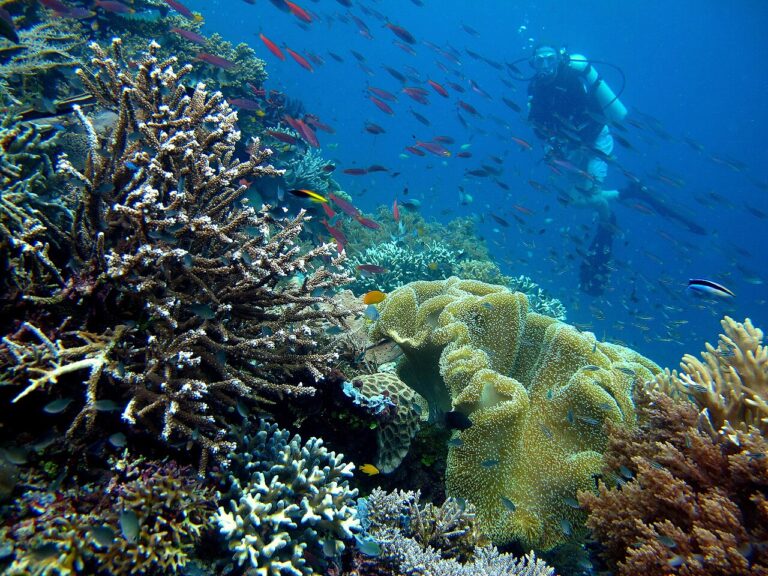 Raja Ampat: Diving the Heart of the Coral Triangle