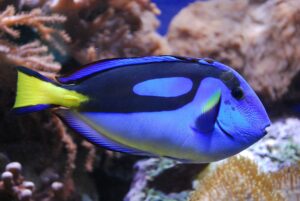
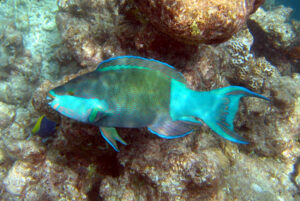
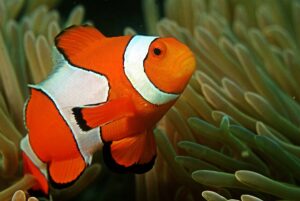
Pufferfish are slow-swimming fish famous for inflating into a ball when threatened. Many species are highly poisonous, and their unusual defences make them among the most fascinating fish on coral reefs.
Interesting facts
- Pufferfish inflate by rapidly swallowing water, becoming too big and round for many predators to swallow.
- Their toxin is produced by bacteria and builds up through their diet.
- Their teeth are fused into four plates that form a beak strong enough to crush shells.
- Male white-spotted pufferfish build elaborate circular patterns in the sand, about 2 m wide, to attract females.
- Some species have spines that stand up when they inflate.
- Pufferfish swim slowly, using small fins rather than their tails.
Behaviour
Pufferfish are mostly solitary. They use their eyesight and agility to find prey among rocks and coral, and rely on inflation and toxins rather than speed to escape predators.
Breeding and young
Most species spawn in pairs or small groups. In some species, males guard the eggs until they hatch.
Threats and conservation
Some species are affected by overfishing, the aquarium trade and the loss of coral reefs and mangroves.
Where to see it
- Coral reefs of the Red Sea, the Maldives and Southeast Asia
- Great Barrier Reef, Australia
- Caribbean reefs
- Public aquariums worldwide
Status source: IUCN Red List. Profile last reviewed September 2026.