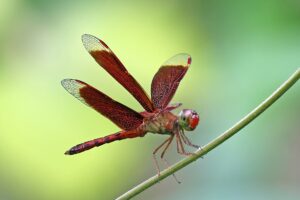
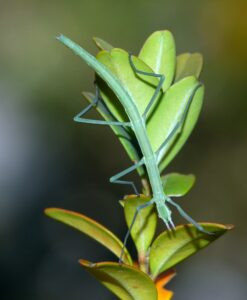
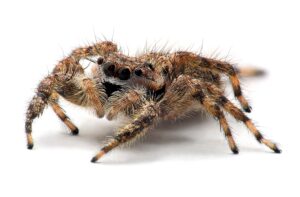
Praying mantises are predatory insects with triangular heads, large eyes and grasping front legs. They are masters of camouflage and ambush, and some species are found in gardens around the world.
Interesting facts
- Mantises get their name from the way they hold their spiked front legs, as if praying.
- They can turn their heads about 180 degrees to look over their shoulders.
- Their strikes can be faster than the blink of an eye.
- Orchid mantises look like flowers and ambush insects that come to feed.
- Females sometimes eat males during or after mating, although this happens less often in the wild than in captivity.
- Females lay eggs in a foamy case called an ootheca, which hardens to protect them.
Behaviour
Mantises wait motionless, often swaying like a leaf in the wind, then strike with lightning speed. Many species are green or brown, and some mimic flowers, leaves or sticks.
Breeding and young
After mating, the female lays tens to hundreds of eggs in an ootheca attached to a stem or wall. Tiny nymphs hatch and grow by moulting several times.
Threats and conservation
Most species are not known to be threatened, although habitat loss and pesticides affect some.
Where to see it
- Gardens and meadows in southern Europe in late summer
- Rainforests of Malaysia, for orchid mantises
- Grasslands and gardens across North America, Africa and Asia
- Insect houses at zoos and butterfly parks
Status source: IUCN Red List. Profile last reviewed September 2026.