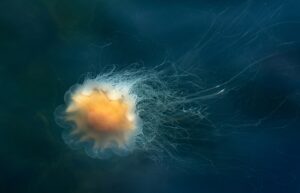
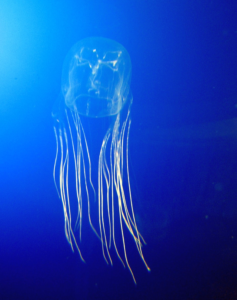
The moon jellyfish is a common, translucent jellyfish found in coastal waters around the world. Its gentle pulsing makes it a favourite in public aquariums.
Interesting facts
- Four horseshoe-shaped rings visible through the bell are its reproductive organs.
- Its sting is very mild and harmless to people.
- Moon jellyfish start life as tiny polyps attached to the seabed, which bud off baby jellyfish.
- Huge blooms of moon jellyfish can clog power station water intakes.
- In 1991, moon jellyfish polyps flew on a Space Shuttle mission to study how gravity affects development.
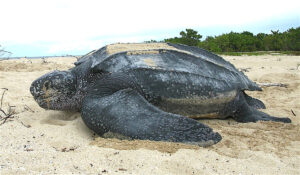
- Leatherback turtles and ocean sunfish eat moon jellyfish.
Behaviour
Moon jellyfish drift with currents, pulsing their bells to stay near the surface. They catch plankton on a sticky layer of mucus.
Breeding and young
Adults release eggs and sperm, producing larvae that settle as polyps. Each polyp can produce many young jellyfish by budding.
Threats and conservation
Not threatened; blooms may be increasing because of overfishing, warming and pollution.
Where to see it
- Coastal bays and harbours worldwide in summer
- Monterey Bay Aquarium, California
- Public aquariums worldwide
- Beaches after onshore winds
Status source: IUCN Red List. Profile last reviewed September 2026.