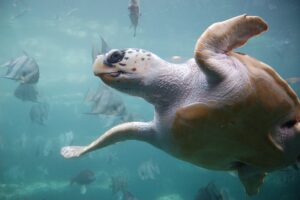
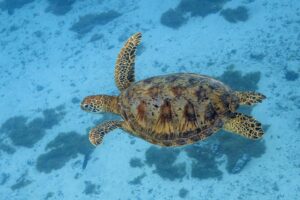
The hawksbill is a beautiful, medium-sized sea turtle of tropical coral reefs, named for its hawk-like beak. Centuries of hunting for its shell have made it one of the most endangered sea turtles.
Interesting facts
- Its beautiful overlapping shell plates were the source of ‘tortoiseshell’ used in jewellery and combs.
- Millions of hawksbills were killed for their shells over the last two centuries.
- International trade in hawksbill shell has been banned since 1977.
- Its narrow, pointed beak reaches into cracks in coral reefs.
- Divers have filmed hawksbills glowing under blue light, a phenomenon called biofluorescence.
- It is critically endangered worldwide.
Behaviour
Hawksbills spend much of their time on coral reefs, feeding on sponges and resting in caves and ledges. They migrate between feeding areas and nesting beaches.
Breeding and young
Females nest every two to three years, laying several clutches of about 130–160 eggs, often under vegetation at the back of beaches.
Threats and conservation
Illegal trade in shell and eggs, loss of coral reefs, beach development, fishing gear and climate change.
Where to see it
- Cousin Island, Seychelles
- Barbados and other Caribbean islands
- Great Barrier Reef, Australia
- Red Sea coral reefs
Status source: IUCN Red List. Profile last reviewed September 2026.