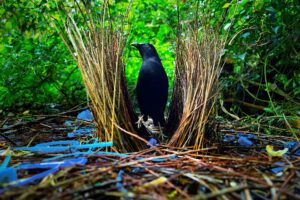
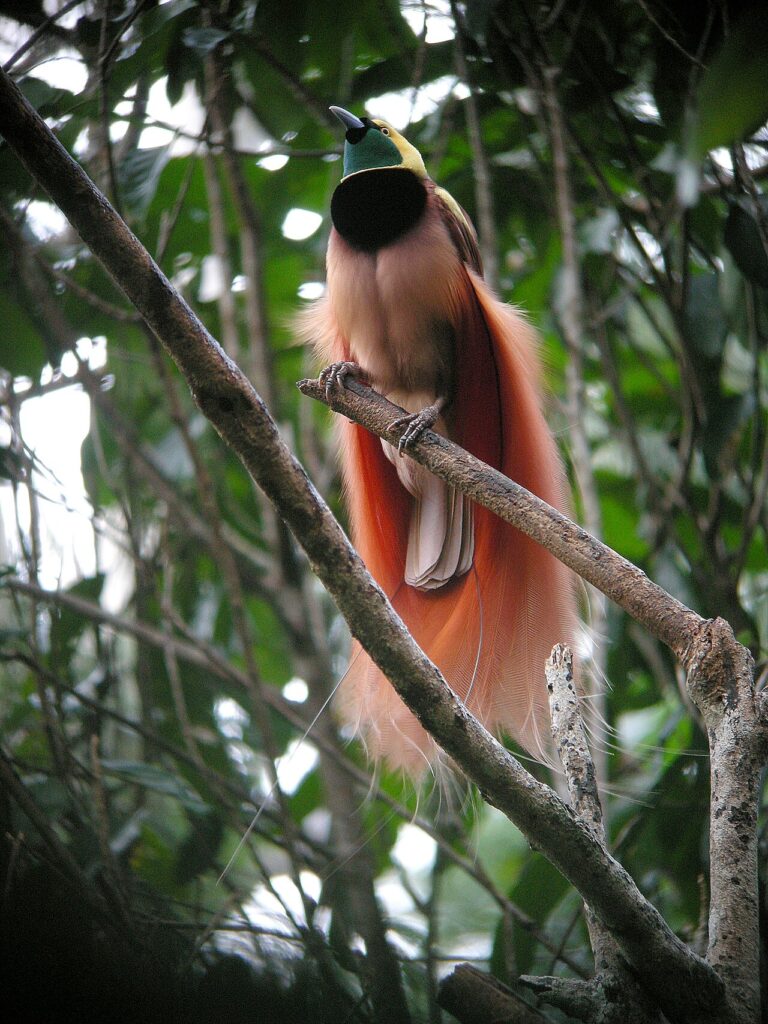
The greater bird-of-paradise is a large, spectacular bird of the New Guinea region. Males are among the most ornate birds in the world, and their communal displays are one of nature’s great spectacles.
Interesting facts
- It is the largest member of the genus Paradisaea.
- Males have long, golden-yellow plumes from their flanks, used in display.
- Groups of males display together at treetop leks, bowing and shaking their plumes.
- Females are plain brown and choose mates by watching the displays.
- Traders once sold its plumes to decorate European hats.
- Alfred Russel Wallace studied birds of paradise in the Aru Islands in the 1850s.
Behaviour
Males gather at display trees at dawn, calling loudly and performing elaborate displays with raised plumes, while females visit to choose a mate. Males take no part in nesting.
Breeding and young
The female builds a cup-shaped nest and raises the chicks alone, usually laying one or two eggs.
Threats and conservation
The species is common in suitable forest, but it faces local hunting and trapping, and habitat loss from logging and plantations.
Where to see it
- Aru Islands, Indonesia, at display trees near villages such as Wakua
- Lowland forests of southern Papua, Indonesia
- Guided birdwatching tours in New Guinea
- Some specialist bird parks
Status source: IUCN Red List. Profile last reviewed September 2026.
Where to see the greater bird-of-paradise
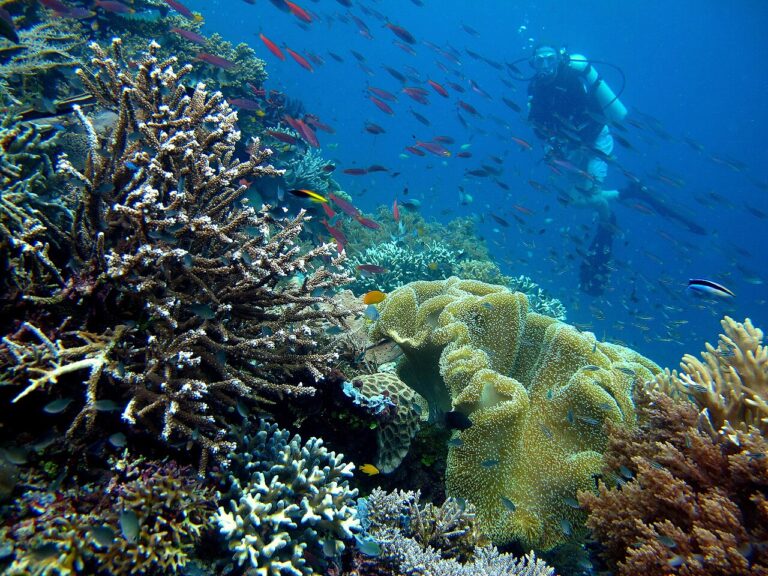 Raja Ampat: Diving the Heart of the Coral TriangleRaja Ampat has the highest marine biodiversity on Earth. How to plan a dive or snorkel trip, from…
 Birds-of-Paradise in Papua New GuineaPapua New Guinea is the heartland of the birds-of-paradise, with dazzling courtship displays found nowhere else. Where to…