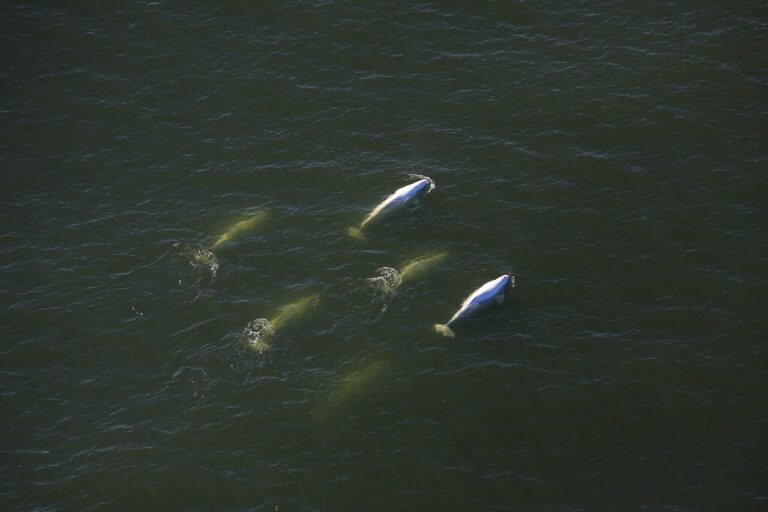
The beluga is a small, white whale of the Arctic and subarctic. Highly social and vocal, it lives in pods and migrates between winter feeding areas in the pack ice and summer gatherings in shallow river estuaries.
Interesting facts
- Unlike most whales, belugas have unfused neck vertebrae, so they can nod and turn their heads.
- Their rounded forehead, called the melon, can change shape as they make sounds.
- Calves are born grey and turn white as they mature.
- Belugas moult each summer, rubbing their skin on gravel in shallow estuaries.
- Thousands gather in the Churchill River estuary in Canada each summer.
- They have no dorsal fin, which helps them swim under sea ice.
Behaviour
Belugas live in pods of a few to dozens of animals, and gather in thousands in summer estuaries. They use echolocation to find prey and breathing holes in ice. They can dive to several hundred metres, sometimes deeper.
Breeding and young
After a gestation of about 14–15 months, a single calf is born, usually in spring or summer. Calves nurse for about two years.
Threats and conservation
Climate change and sea-ice loss, shipping noise, pollution, oil and gas development, and hunting. The St. Lawrence and Cook Inlet populations are small and endangered.
Where to see it
- Churchill, Manitoba, Canada, in July and August
- Tadoussac and the Saguenay–St. Lawrence Marine Park, Quebec
- Cunningham Inlet, Somerset Island, Nunavut
- Svalbard, Norway
Status source: IUCN Red List. Profile last reviewed September 2026.
 Beluga Whales in Churchill: Summer Guide
 Narwhal and Polar Bear Expeditions in Arctic Canada