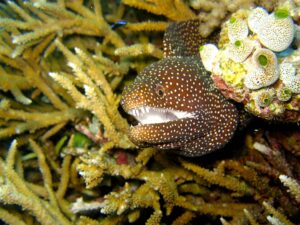
The European eel is a snake-like fish with one of the most mysterious life cycles in nature. Once abundant across Europe, it has collapsed and is now Critically Endangered.
Interesting facts
- Their larvae drift on the Gulf Stream for one to three years to reach Europe.
- Young eels are transparent and called glass eels.
- The number of young eels reaching Europe has fallen by about 90–95 percent since the 1980s.
- Smuggling of glass eels to Asia is thought to be one of Europe’s biggest wildlife crimes.
- Eels can wriggle over land on wet nights to reach new waters.
- Lough Neagh in Northern Ireland has one of Europe’s largest wild eel fisheries.
Behaviour
Eels spend years in rivers and lakes, mostly active at night. When mature, they turn silver and swim back across the Atlantic to breed.
Breeding and young
Eels are thought to spawn once, deep in the Sargasso Sea, and then die. The tiny, leaf-shaped larvae drift back to Europe.
Threats and conservation
Dams and weirs blocking migration, hydropower turbines, overfishing and illegal trade, pollution, parasites and changes in ocean currents.
Where to see it
- River Severn, England, during glass eel runs in spring
- Lough Neagh, Northern Ireland
- Comacchio lagoons, Italy
- Rivers and canals across Europe (mostly at night)
Status source: IUCN Red List. Profile last reviewed September 2026.