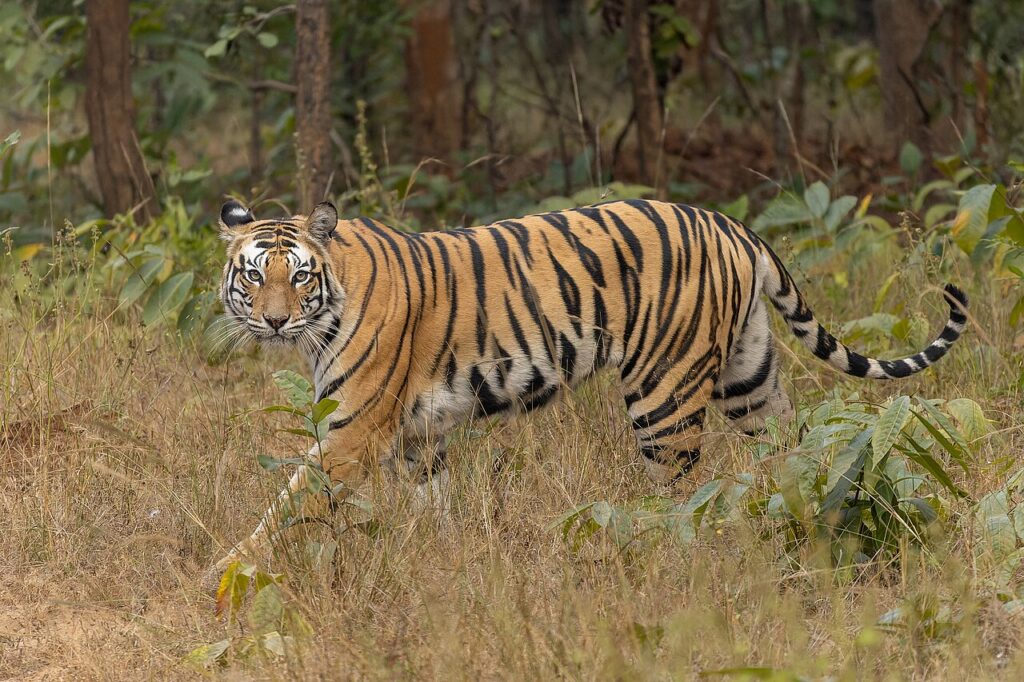
India is the best country in the world to see a wild tiger. The 2022 national tiger estimation put the population at about 3,680, roughly three-quarters of all wild tigers on Earth, spread across more than 50 tiger reserves. In some reserves, tigers are seen on a large share of safaris during the dry season. This guide covers the best places to go, when to visit and how to plan.
When to go
Most tiger reserves in central and northern India are open from mid-October to June. Core zones close during the monsoon, usually from July to September, although some buffer zones stay open.
| Period | Conditions | Tiger sightings |
|---|---|---|
| October to November | Lush and green after the monsoon | Fair; tigers spread out with plenty of water |
| December to February | Cool, sometimes cold mornings, pleasant days | Good; beautiful light |
| March to June | Hot and dry, up to 45 °C in May | Best; tigers gather near waterholes and vegetation thins |
If seeing a tiger is your main goal, travel between March and May and book several safaris. If you prefer pleasant weather and a greener landscape, travel between November and February.
The best tiger reserves
1. Bandhavgarh National Park, Madhya Pradesh
Bandhavgarh has one of the highest densities of tigers in India and a reputation for frequent sightings, particularly in the Tala zone. Its landscape of sal forest, grassy meadows and rocky hills crowned by an ancient fort is spectacular. It is also good for leopards, sloth bears and gaur.
- Best for: high tiger density and repeat sightings.
- Nearest access: Umaria railway station; Jabalpur airport (about four to five hours by road).
2. Tadoba-Andhari Tiger Reserve, Maharashtra
Tadoba has become one of India’s most reliable tiger reserves, with frequent sightings around its lakes and waterholes. It also holds sloth bears, leopards and dholes. Its buffer zones offer good sightings with fewer vehicles.
- Best for: tiger sightings, dholes and sloth bears.
- Nearest access: Nagpur airport (about three hours by road).
3. Kanha National Park, Madhya Pradesh
Kanha’s vast meadows and sal forests are often linked with the landscapes of Rudyard Kipling’s The Jungle Book. It is well managed and scenic, and it is the only place to see the hard-ground barasingha (swamp deer), which was saved from extinction here. Tiger sightings are good, although the park is large.
- Best for: landscapes, barasingha, overall wildlife.
- Nearest access: Jabalpur airport (about four hours) or Nagpur (about six hours).
4. Ranthambore National Park, Rajasthan
Ranthambore is India’s most famous tiger reserve, known for tigers photographed among ruined palaces, lakes and a 10th-century fort. It is dry deciduous forest, making tigers relatively visible. It is also the easiest reserve to combine with the Golden Triangle of Delhi, Agra and Jaipur, which means it can be busy.
- Best for: iconic scenery and easy access from Delhi and Jaipur.
- Nearest access: Sawai Madhopur railway station; Jaipur (about three hours by road).
5. Pench National Park, Madhya Pradesh and Maharashtra
Pench lies in the Seoni hills, where Kipling set much of The Jungle Book. It has teak forests and a river running through it. It is known for good tiger and leopard sightings and is often combined with Kanha and Tadoba.
- Best for: combining with Kanha or Tadoba; leopards.
- Nearest access: Nagpur airport (about two to three hours).
6. Jim Corbett National Park, Uttarakhand
India’s oldest national park, founded in 1936, sits in the Himalayan foothills. Tigers are present in good numbers but the terrain makes sightings less predictable than in central India. Corbett is excellent for elephants, birds and scenery, and the Dhikala zone offers forest lodge stays inside the park.
- Best for: elephants, birds, Himalayan foothill scenery.
- Nearest access: Ramnagar; about six to seven hours by road from Delhi.
7. Kaziranga National Park, Assam
Kaziranga is famous for greater one-horned rhinos, but it also has one of the highest tiger densities in the world. Tigers are harder to see in its tall grasslands, but rhinos, wild water buffalo, elephants and swamp deer are almost guaranteed.
- Best for: rhinos and a mix of big wildlife.
- Nearest access: Jorhat or Guwahati airports.
8. Nagarhole and Bandipur, Karnataka
In South India, the Kabini side of Nagarhole National Park is famous for leopards, including the occasional black leopard, and large elephant herds in the dry season. Tigers are regularly seen too.
- Best for: leopards, elephants and river-based safaris.
- Nearest access: Bengaluru or Mysuru.
9. The Sundarbans, West Bengal
The world’s largest mangrove forest is home to tigers adapted to swimming between islands and living in a tidal forest. Sightings are rare, but boat safaris through the mangrove channels are a unique experience.
- Best for: an unusual habitat and adventure; not for guaranteed sightings.
10. Satpura National Park, Madhya Pradesh
Satpura offers something different: walking safaris, canoeing and night drives in the buffer zones. Tiger sightings are less frequent, but it is excellent for sloth bears, leopards, birds and a quieter experience.
- Best for: walking and canoe safaris, fewer crowds.
How safaris work
- Zones: each reserve is divided into zones, and your permit is for a specific zone and time slot (morning or afternoon). Core zones generally offer better sightings but are in high demand; buffer zones can be excellent and less crowded.
- Vehicles: most safaris use open six-seater “gypsy” jeeps with a driver and a mandatory park guide. Ranthambore also uses larger 20-seater “canters”.
- Timings: morning safaris start around sunrise and last three to four hours; afternoon safaris end at sunset.
- Booking: permits for most reserves are sold through official state online portals, and popular zones often sell out months in advance, especially for March to May. Many travellers book through lodges or operators, who handle permits.
- How many safaris? Plan at least four to six safaris in one reserve, or split them between two reserves, to give yourself a strong chance.
Tips for ethical tiger watching
- Do not pressure your driver or guide to chase tigers or get closer. Crowding a tiger at a waterhole or on a road can stress it and change its behaviour.
- Stay quiet and still at sightings.
- Choose operators who follow park rules and respect vehicle limits.
- Look beyond the tiger. India’s reserves hold leopards, sloth bears, dholes, gaur, deer, crocodiles and hundreds of bird species.
- Support local communities by staying in locally run lodges and hiring local naturalists.
A sample 12-day central India tiger itinerary
- Day 1: arrive in Nagpur; drive to Tadoba (three hours).
- Days 2–4: six safaris in Tadoba’s core and buffer zones.
- Day 5: drive to Pench (about four hours); afternoon safari.
- Days 6–7: safaris in Pench.
- Day 8: drive to Kanha (about five hours).
- Days 9–11: safaris in Kanha.
- Day 12: drive to Jabalpur for your onward flight.
Frequently asked questions
Where is the best place to see tigers in India? Bandhavgarh, Tadoba, Kanha, Ranthambore and Pench offer the highest chances in central and northern India.
What is the best month to see tigers in India? April and May, when it is hot and dry and tigers visit waterholes, although December to February is more comfortable.
Are tiger sightings guaranteed? No. Even in the best reserves, sightings depend on luck. Booking several safaris greatly improves your chances.
Can I combine a tiger safari with the Taj Mahal? Yes. Ranthambore is the easiest reserve to add to a Delhi–Agra–Jaipur trip.
Is it better to see tigers in India or Nepal? India’s central reserves generally offer more frequent sightings. Nepal’s Chitwan and Bardiya offer a wilder, less crowded experience and are easy to combine with trekking.
Related guides
- Chitwan National Park safari guide
- Wildlife of Asia
- Animal profiles: Tiger, Leopard
- Learn: How India counts its tigers
Cover photo: Tisha Mukherjee, CC BY-SA 4.0, via Wikimedia Commons