The emu is Australia’s largest bird, a nomadic wanderer that follows rain and food across the continent. It remains widespread and common on the mainland.
Interesting facts
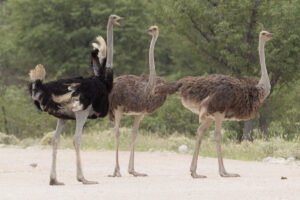
- The emu is the second-largest living bird after the ostrich.
- Emus make deep booming and drumming sounds using an inflatable neck pouch.
- Emus can swim well.
- They disperse the seeds of many plants over long distances.
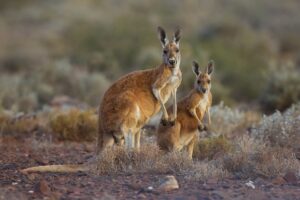
- An emu features on Australia’s coat of arms alongside the kangaroo.
- The dwarf emus of King Island and Kangaroo Island became extinct in the 1800s.
Behaviour
Emus are usually seen alone, in pairs or in small groups, and can travel long distances to find food and water.
Breeding and young
The female lays dark green eggs, and the male incubates them and cares for the striped chicks for up to about 18 months.
Threats and conservation
Widespread; local threats include habitat clearing, fences, vehicles and predation of chicks by foxes and dogs.
Where to see it
- Flinders Ranges, South Australia
- Wilsons Promontory, Victoria
- Outback New South Wales and Western Australia
Status source: IUCN Red List. Profile last reviewed September 2026.