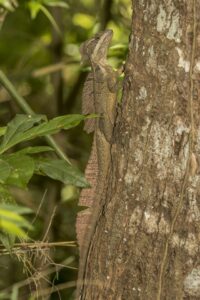
The green iguana is a large, tree-dwelling lizard of the American tropics. It is common in many places, often basking in trees along rivers.
Interesting facts
- A pale scale on top of its head, called the parietal eye, senses light and helps detect predators from above.
- Iguanas are strong swimmers and often dive into rivers to escape danger.
- Despite the name, green iguanas can be orange, brown or grey.
- In parts of Central America, iguanas are eaten and nicknamed ‘chicken of the trees’.
- In Florida, cold snaps can leave iguanas stunned and falling from trees.
- Males have large dewlaps and bob their heads in displays.
Behaviour
Iguanas spend much of their time basking in trees and feeding on leaves. Males are territorial and display with head bobs and dewlap extensions.
Breeding and young
Females dig nests and lay about 20–70 eggs, which hatch after about three months.
Threats and conservation
The species is common, although it is hunted for meat and eggs and collected for the pet trade.
Where to see it
- Tortuguero National Park, Costa Rica
- Parks in Cartagena, Colombia
- Panama Canal area
- Southern Florida (invasive)
Status source: IUCN Red List. Profile last reviewed September 2026.