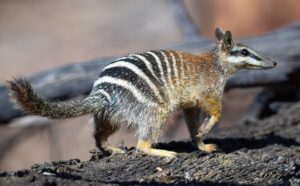
The greater bilby is a small, burrowing marsupial of Australia’s deserts, with long ears and a silky grey coat. It has disappeared from most of its former range and is a symbol of Australia’s endangered wildlife.
Interesting facts
- Its long, rabbit-like ears help it hear prey and lose heat.
- Bilbies dig spiral burrows up to about 2 metres deep.
- The pouch opens backwards, so it does not fill with soil while digging.
- The lesser bilby became extinct in the 1950s.
- Bilbies do not need to drink, getting water from their food.
- Each bilby digs many burrows, which other animals also use.
Behaviour
Bilbies are nocturnal and solitary. They dig for food with strong front claws, turning over large amounts of soil and helping seeds grow.
Breeding and young
After only about 14 days, one to three tiny young crawl into the pouch, where they stay for about 80 days.
Threats and conservation
Predation by feral cats and foxes, competition with rabbits and livestock, and changes to fire patterns.
Where to see it
- Charleville Bilby Experience, Queensland
- Arid Recovery Reserve, Roxby Downs, South Australia
- Sturt National Park (Wild Deserts project), New South Wales
- Currawinya National Park, Queensland (fenced area)
Status source: IUCN Red List. Profile last reviewed September 2026.